
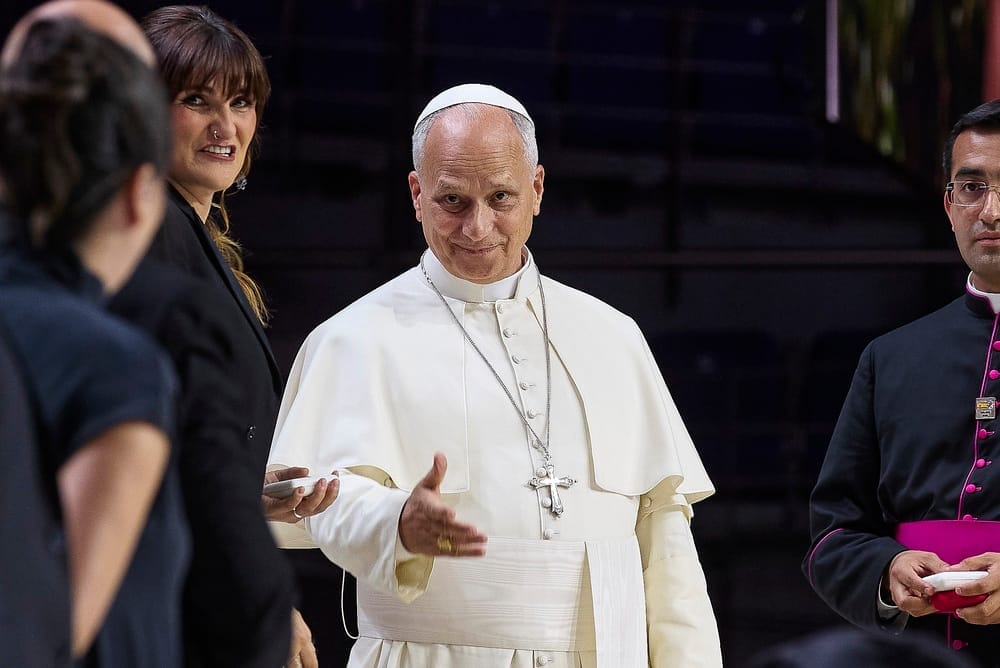
PARIS — September 2026 — As artificial intelligence rapidly enters business, government, education, healthcare, and everyday life, Pope Leo XIV has called for something technology itself cannot provide: ethical discernment.
During his apostolic visit to France, which began September 25, the Pope addressed political and civic leaders at the Élysée Palace before speaking later that day at UNESCO headquarters in Paris. Across both appearances, a consistent theme emerged: technological advancement must remain anchored in human dignity, moral responsibility and the capacity of people to distinguish not merely what is possible, efficient or profitable, but what is genuinely good.
At the Élysée Palace, Pope Leo warned of the danger of allowing technology to shape humanity rather than humanity determining how technology should be used.
He called for:
“an urgent need for education in ethical discernment and the capacity to acknowledge the moral good.”
The purpose, he said, is to ensure that human flourishing, freedom and dignity remain central as artificial intelligence becomes increasingly embedded in society.
For the World Ethics Organization, this raises an issue that extends far beyond religion and far beyond artificial intelligence.
It is a question facing every institution adopting powerful new technologies:
Who decides what “good” looks like?
Technology Can Tell Us What Is Possible. It Cannot Tell Us What Is Right.
The extraordinary capabilities of artificial intelligence can sometimes blur an essential distinction.
A system can analyze enormous quantities of information.
It can recognize patterns.
It can recommend actions, optimize processes, predict behaviours and increasingly produce work that once required substantial human expertise.
But none of those capabilities, by themselves, determine whether a decision is ethical.
At UNESCO, Pope Leo drew attention to precisely this distinction. Artificial intelligence can correlate data, he observed, but it cannot answer the deepest questions concerning the meaning of human life because those questions are rooted in lived human experience.
That distinction deserves considerably more attention.
We are entering an era in which organizations may increasingly be tempted to substitute algorithmic recommendations for human judgment.
Yet efficiency is not ethics.
Optimization is not wisdom.
Prediction is not moral responsibility.
And intelligence — artificial or otherwise — is not synonymous with judgment.
The Risk of Measuring Human Worth by Efficiency
Perhaps one of the most important aspects of Pope Leo's UNESCO address was his warning against evaluating human beings primarily through measures of productivity and usefulness.
He described a troubling paradox: while society increasingly attributes “intelligence” to computational systems, it can simultaneously struggle to recognize the inherent dignity of people whose lives do not satisfy conventional standards of efficiency or productivity.
This is not simply a philosophical concern.
It has real implications for how artificial intelligence is deployed.
Consider the decisions increasingly influenced by automated systems: Who receives a loan? Who is shortlisted for employment? Who receives healthcare resources? Whose insurance claim receives additional scrutiny? Which students are identified as promising? Which customers receive priority? Which communities receive investment? Which information appears in front of millions of people?
Each decision may involve data and efficiency. But each may also involve fairness, dignity, accountability, transparency, and human consequences.
An algorithm can calculate. Human beings remain responsible for deciding whether the outcome is just.
Ethical Discernment Must Become a Core Human Capability
This is where the Pope's use of the word discernment becomes particularly important. Ethical discernment is more than compliance. Organizations can follow regulations and still face serious ethical dilemmas.
Rules cannot anticipate every circumstance created by rapidly evolving technology. Nor can an ethics policy sitting quietly inside a corporate handbook make difficult decisions on behalf of leaders.
Ethical discernment requires people capable of stopping long enough to ask: Who benefits from this decision? Who could be harmed? Whose interests are missing from the conversation? What assumptions are built into the data or system? Are we doing this because it is right — or simply because we can? Would we be comfortable explaining this decision publicly to the people affected by it? Does this decision protect human dignity?
These questions belong not only in philosophy classrooms or ethics committees. They belong in boardrooms, technology companies, in government, in schools and universities . Increasingly, they belong in almost every organization adopting artificial intelligence.
Information Is Not Wisdom
At UNESCO, Pope Leo also drew another distinction with profound implications for the digital age. The world has more information than ever before, but more information does not necessarily produce greater wisdom. Communication has become extraordinarily fast, while truth has not necessarily become easier to identify. AI magnifies that challenge.
Artificial intelligence can generate, distribute, and personalize information at a scale humanity has never experienced before. Used responsibly, these capabilities can expand education, accessibility and human knowledge.
Used irresponsibly, the same capabilities can accelerate misinformation, manipulation and division.
The Pope consequently connected technological responsibility with education, media literacy and the pursuit of truth, warning that science itself can lose its proper purpose when separated from ethics.
That observation points toward one of the defining challenges of this century. We do not merely need populations capable of using technology. We need people capable of judging technology.
Ethical Dialogue Requires Different Voices
Pope Leo also connected ethical discernment with freedom of conscience and pluralism.
At the Élysée Palace, he argued that a genuinely free society should protect diversity of conscience rather than imposing uniformity, and should encourage ethical dialogue across different cultural and religious perspectives.
That principle is especially relevant to global discussions surrounding artificial intelligence.
It is unlikely that a single institution, government, religion, company, or culture can answer every ethical question arising from AI. The conversation must therefore be broader. Technologists must be part of it. So must business leaders, governments, educators, philosophers, scientists, faith communities, civil society and young people. And, critically, people whose lives are affected by technological decisions but who rarely have a seat at the table where those systems are designed.
Ethics cannot be added to technology after engineering is complete. It must help shape the questions asked before the technology is built and deployed.
From Artificial Intelligence to Human Responsibility
There is an understandable tendency to frame the present debate around AI in terms of what machines may eventually become capable of doing. Perhaps the more immediate question concerns what human beings will choose to do with them.
Artificial intelligence does not relieve organizations, governments or individuals of moral responsibility. It increases it.
The more powerful our tools become, the greater our responsibility to understand their consequences. And as decision-making becomes faster and increasingly automated, society may need something that sounds almost countercultural: the willingness to slow down long enough to make an ethical judgment.
The question should therefore not simply be: Can AI make this decision? It should also be: Should AI make this decision? And ultimately: Who remains accountable for the consequences?
A Global Conversation We Need Now
Pope Leo XIV's addresses in Paris arrive at an important moment.
Artificial intelligence is developing much faster than many institutions can establish governance structures, social norms, and ethical frameworks around it. That gap should concern us. But it should also motivate us.
The future of artificial intelligence need not be a choice between technological progress and human values.
The more constructive challenge is ensuring that progress remains directed by those values.
From the perspective of the World Ethics Organization, that requires more than regulation. It requires ethical education. It requires dialogue between different cultures and perspectives. It requires leaders willing to consider consequences beyond the next quarter's results. It requires institutions capable of protecting human dignity even when doing so may be less efficient.
And above all, it requires individuals capable of ethical discernment.
Technology will continue advancing. The harder task is ours: ensuring that our wisdom, responsibility and humanity advance with it.
World Ethical News: Advancing the global conversation on ethics, leadership, technology and human responsibility.
Sources: Pope Leo XIV, address to authorities, civil society and the diplomatic corps at the Élysée Palace, Paris, September 25, 2026; and address at UNESCO headquarters, Paris, September 25, 2026.
#ArtificialIntelligence #EthicalLeadership #HumanResponsibility #Ethics #Technology #HumanDignity #CriticalThinking